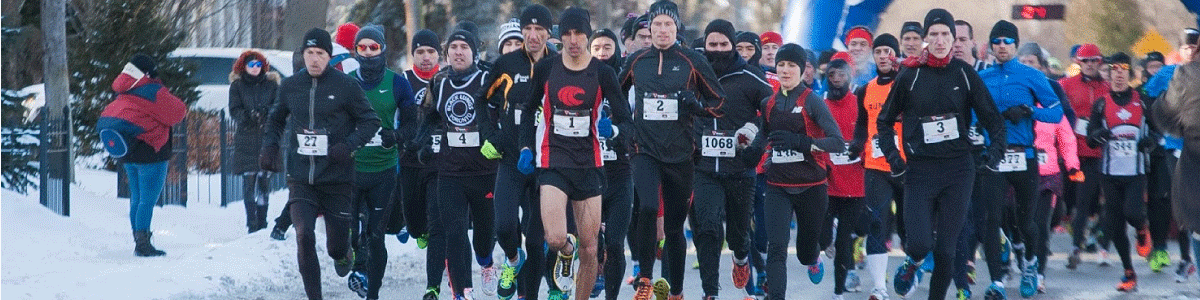
Simon Fraser University track & field blindsided by elimination threat
Was SFU's decision to leave the NCAA a smokescreen to cut track and field entirely?

SFU Athletics
Last week’s announcement that Vancouver’s Simon Fraser University (SFU) plans to end its 14-year run as Canada’s only NCAA school came as a massive blow to its track and field program. While athletes and coaches expected the loss of outdoor track that would accompany SFU’s application to join U Sports (because there is no outdoor track season in U Sports), they were astounded to learn that the indoor track program is also under review.
The announcement closely follows a similar announcement by McGill University that it is cutting its track and field program.
Head track and cross-country coach Brit Townsend says coaches were not included in decision-making and were told only on Nov. 24 that indoor track was in jeopardy. “That was never on the table,” she told Canadian Running.

Priority #1: protect indoor track
SFU has applied to U Sports (for all of its varsity sports) and expects to receive a decision in spring 2026; if accepted, the school would leave NCAA Division II (which it has been a part of since 2011) at the end of the 2026-27 school year.
Townsend, a former SFU track star, Olympian and Pan Am Games 1,500m bronze medallist who has coached at SFU for nearly 30 years, has accepted the team’s likely U Sports fate. “It’s out of our hands,” Townsend said. “We gave our input, but it was never really in our control.”
In the meantime, her priority is protecting the indoor program. The school’s executive team points to Vancouver’s lack of an indoor track for training as a key reason for cutting the indoor team, which strikes stakeholders as a red herring; mild weather allows athletes to train outdoors nearly all year, and it hasn’t stopped SFU from competing in indoor track in the NCAA, nor placing athletes on national indoor teams.
View this post on Instagram
Townsend points out that SFU has been involved in developing Olympians in multiple sports, across national teams and world championships, adding that she’s already created a model of an updated SFU track program to present to the school’s athletic director and university leadership. Athletics Canada is also expected to lend its support to the plan.
Background on SFU’s decision to leave the NCAA
SFU’s provost and VP Academic, Dilson Rassier, told Canadian Running the move follows a strategic review (the McLaren report) focused on updated goals and financial sustainability of the school’s sports programs. The review estimates the total annual cost savings of joining U Sports (which eliminates outdoor track, women’s softball and men’s and women’s golf programs, which do not exist in U Sports) is C$1.1 million.

Rassier says the intention was “to become more part of Canadian sports culture and engaged with other Canadian universities,” and the decision “was made to benefit all students, not just student athletes.”
Rassier admitted that most of the more than 100 student-athletes who were consulted wanted to remain in the NCAA. “Athletes have shown disappointment,” he said, “but the reactions have been balanced, and they understand the reasons why.” The 104-page report was submitted Nov. 15 and the decision to move to U Sports was announced nine days later, on Nov. 24. Rassier also said he does not believe the school’s ability to recruit student-athletes will be negatively affected by a move to U Sports.
Determined to excel in U Sports
“We have to accept our position in U Sports and be the best we can,” Townsend said. “We have always prided ourselves on high performance. We have to create an environment where people can excel and be offered the highest level of opportunity–I know we can do that, because we’ve been doing it for years.”

Townsend admits it will be a steep learning curve for her as a coach, but with two years left in the NCAA, she still has some time to see what SFU athletics can do to make their program unique. “U Sports has been successful for a lot of athletes,” she said. “Hopefully, our athletes choose to stay with us.” SFU already has strong athlete support in place–some NCAA-mandated and others that SFU simply saw were important; these include academic advisors, treatment staff, tutoring and mental well-being resources.
Townsend has also spoken to University of Toronto coach Terry Radchenko about having an outdoor team associated with the school, to allow SFU athletes to continue competing outdoors.”We might follow the University of Toronto Track Club and do some outdoor meets,” she said.

Recruitment, Townsend believes, will likely be hindered in the short term. The key concerns now are how many athletes might transfer (either to NCAA schools, or potentially to U Sports schools that are closer to their hometowns); there’s a lot of uncertainty for newcomers and high performers who chose SFU for the NCAA competition.
Athlete interests pushed aside
For many SFU athletes, the decision to leave the NCAA feels less like a strategic shift and more like a dismissal of the athletes most affected. Athletes have spoken out through surveys, interviews, petitions and through their Student-Athlete Advisory Committee (SAAC) committee, which created an open letter to the SFU community.

First-year sprinter Zach Jeggo, the 2025 U20 national champion in the 400m hurdles, will lose his primary event entirely once outdoor track disappears (there is no 400m hurdles event in indoor track). “I have nothing against U Sports, but I believe the NCAA provides a stronger environment for athletic and personal development,” he told Canadian Running. “It’s evident the university’s executives did not truly listen to athletes–our concerns seemed to be completely disregarded.”
Jeggo says he turned down U.S. opportunities specifically to race NCAA competition while staying in Canada. “If SFU had been part of U Sports at the time, my decision likely would have been very different,” he added.
Many SFU track athletes, especially those whose events are not offered indoors, are considering transferring. “A lot of us are now reassessing our options,” Jeggo said. “There’s a shared sense among athletes that we were overlooked in this process and left to deal with the consequences on our own.” He emphasized that while the team and coaches at SFU have created an incredible environment, ultimately, the NCAA is where he wants to be.

Former SFU star Marie-Éloïse LeClair, now a 2024 Olympian, core member of Team Canada relay teams and national relay record holder, echoed Jeggo’s concerns. She chose SFU only because it allowed her to stay in Canada and race NCAA competition. “In high school, I didn’t have the times required to attend a big NCAA school in the U.S. with a full-ride scholarship,” LeClair told Canadian Running. “SFU was the best of both worlds.” Had SFU been in U Sports, she says, she would have stayed closer to her home in Quebec.
LeClair said SFU’s NCAA system gave her the exposure and opportunities she needed to reach Team Canada. She believes that even just losing the outdoor season and having to compete in U Sports’ 300m, 600m and 1,000m events (which are different from any other circuit in the world) will change the structure for the worse.
Current SFU sprinter Emma Cannan, who specializes in the 200m, says she also wouldn’t have chosen SFU if not for the NCAA aspect. “I wasn’t interested in running the 300m, being only indoors and having no funding,” she told Canadian Running; the NCAA provided more competition, scholarship support and a chance to compete for All-American honours. “Those opportunities were a big part of my development as an athlete,” she said.
Cannan says athletes were assured of being involved in decision-making, but were not. “The decision sends a clear message that the school doesn’t value its student-athletes,” she said. “Who wants to represent a name on a jersey that doesn’t support you, listen to you and offer the programs and opportunities that brought you here in the first place? Not a single athlete voted in favour of moving to U Sports, and despite that, the final decision was still made.”
Read the McLaren report, here and the open letter from the SAAC to SFU, here.